In this task, I have to get in terms the different setting I can use to give me a different movement of the image.

Frozen Movement - this is achieved by increasing the shutter speed, for example at 1/500 is a perfect shutter speed to capture an image without blurriness. To achieve with a blur then anything below 1/60 would achieve it because it is a much more lower shutter speed.
Blurred movement - This type of photographic skill is the same as frozen movement, however the only difference being that in blurred movement, it can show how fast the object in the background or foreground. To do this, instead of increasing the shutter speed, you can decrease the shutter speed, anything below 1/60 can pick up the blur.


Shallow Depth of Field - Shallow depth of field is when the focus point is slim, and the background being blurred. to achieve this, I had to increase the aperture (I kept mine at F/1.8) this controlled the focus point in the foreground.

Large depth of field - large depth of field is a wide angle lens shot with a small aperture. This type of technique is normally done landscape with a low aperture, anything under f/16 would give the images the right focus point. for this technique, I set my aperture to f/14 on the Canon 1500D
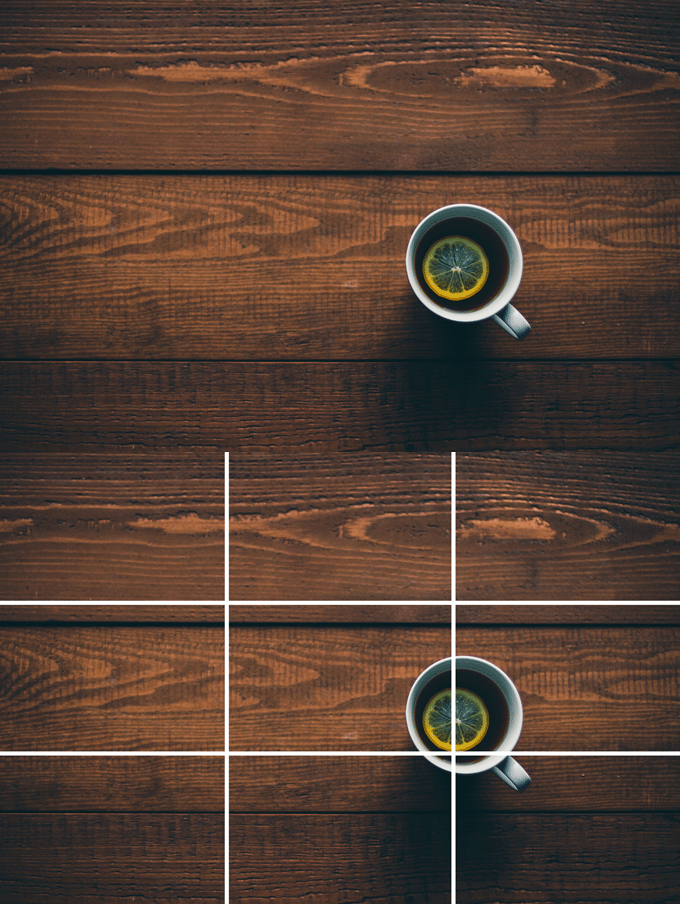
Rules of Thirds - The rules of thirds is commonly used for photographers who are starting out in their photography. it is applied when aligning the main focus point with guidelines and their intersection point.
Pattern and repetition - pattern and repetition is only of the basic concepts in world art. an object which is repetitive can change into a piece of art. to go against this and make the image more interesting, the repetition should be broken to create and even more interesting image.
painting with light - painting with light is a photographic technique in which the exposures mare created through hand movement and hand held light source. whilst doing this I had to take a long exposure photograph. in order to achieve this, you must use a DSLR which would have 'BULB' mode, that way the camera automatically corrects the exposure.

Negative space - Negative space is also known as white space which is the commonly used in art and photography which is where the space around the subject is negative and empty. the negative space around the subject, defines and emphasises the main subject from the 'breathing space', all of this adds up to a more engaging composition.


No comments:
Post a Comment